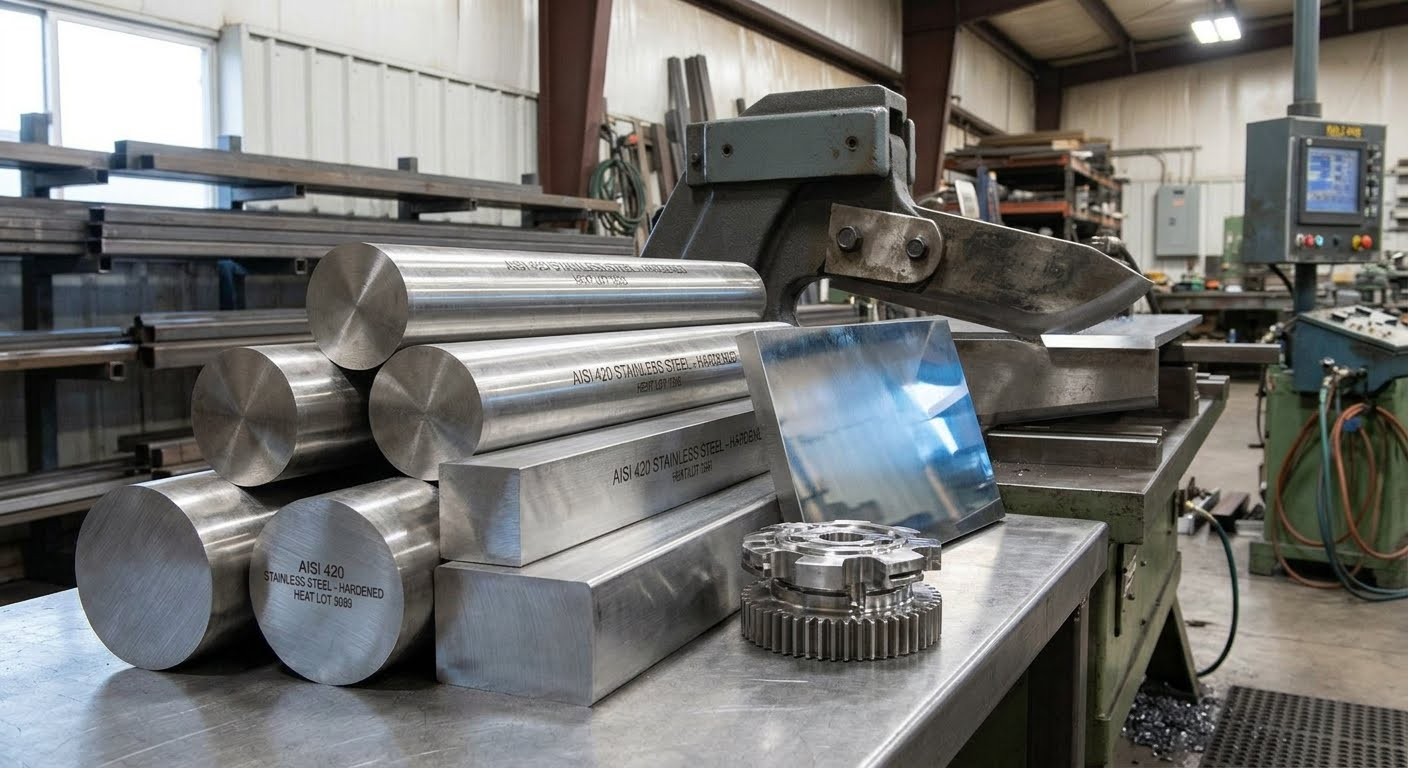
420 stainless steel is a high-carbon, martensitic stainless steel that is magnetic, heat-treatable to a high hardness, and offers moderate corrosion resistance. It is essentially a higher-carbon version of grade 410, designed to optimize strength, wear resistance, and hardness at the expense of slight corrosion resistance and ductility.
Mechanical Properties
- High Hardness: Can be hardened up to 50–57 HRC via heat treatment, making it the hardest among the 12% chromium grades.
- Tensile Strength: Reaches approximately 655–950 MPa depending on the tempered state.
- Yield Strength: Ranges from 345 MPa in its annealed state up to 1,345 MPa when fully hardened.
- Ductility: Good in its soft-annealed state but drops significantly once hardened.
Chemical Composition (wt%)
According to standard UNS S42000 Specifications
- Chromium (Cr): 12.0% – 14.0% (Provides stain and corrosion resistance)
- Carbon (C): 0.15% – 0.40% (Enables high hardenability)
- Iron (Fe): 85% – 88% (Base metal balance)
- Manganese (Mn) & Silicon (Si): ≤ 1.0% each
- Phosphorus (P) & Sulfur (S): ≤ 0.04% and ≤ 0.03% respectively
Physical & Thermal Properties
- Density: 7.74 – 7.75 g/cm³
- Melting Point: 1450 – 1510 °C
- Modulus of Elasticity: 200 GPa
- Magnetism: Strongly magnetic in all conditions due to its martensitic crystal structure.
- Thermal Conductivity: 24.9 W/m·K (at 100°C)
Fabrication Properties
- Corrosion Resistance: It provides excellent resistance to fresh water, mild acids, air, and steam, but only when fully hardened and polished. It will rust if left in an unhardened, annealed state.
- Machinability: Fairly good/moderate (roughly 36% to 56% of free-machining carbon steel) when annealed. A sulfur-modified free-machining version variant 420F Stainless Steel, is used for complex parts.
- Weldability: Generally poor. It is rarely welded because it air-hardens quickly, creating a high risk of cracking unless intense preheating and post-weld tempering are performed.