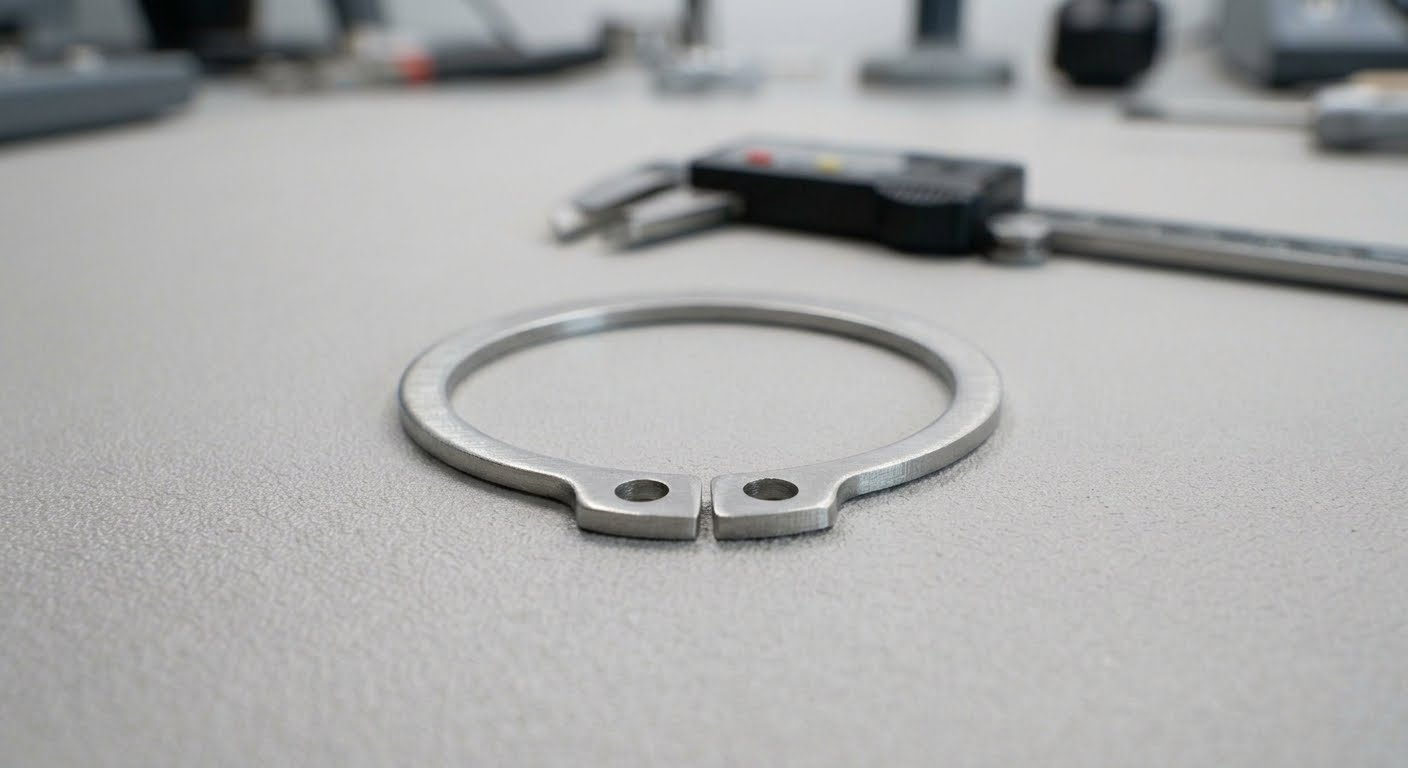
A4 stainless steel circlips—commonly referred to as Grade 316 or marine-grade retaining rings—are semi-flexible fasteners engineered to secure components onto shafts or inside bores in highly corrosive environments. Combining the compact, low-profile mechanical hold of a retaining ring with the superior chemical and saltwater resistance of molybdenum-alloyed steel, they are essential hardware across marine, chemical, food-processing, and subsea engineering.
What Makes A4 Stainless Steel Different?
Standard circlips are typically stamped from carbon spring steel, which offers high tensile strength and elasticity but rusts rapidly when exposed to moisture or chemicals. While A2 (Grade 304) stainless steel offers basic corrosion protection, A4 (Grade 316) steps up performance through a distinct metallurgical upgrade:
- Alloy Composition: A4 stainless steel contains roughly 18% chromium, 10% nickel, and 2% to 3% molybdenum.
- Chloride & Acid Resistance: The addition of molybdenum dramatically improves resistance to pitting and crevice corrosion caused by chlorides (such as seawater and de-icing salts), industrial solvents, and harsh acids.
- Non-Magnetic Properties: As an austenitic stainless steel, A4 is largely non-magnetic, though cold-working during the stamping process can induce a very slight magnetic pull.
Common Types of A4 Circlips
A4 circlips are manufactured to strict international dimensional standards—most notably German DIN specifications—to ensure a precise fit in machined grooves.
| Type | Common Standard | How It Works | Primary Use Case |
|---|---|---|---|
| External Circlips | DIN 471 | Expanded with pliers to slide over a shaft, snapping inward into an outer groove. | Holding bearings, gears, and pulleys onto rotating shafts. |
| Internal Circlips | DIN 472 | Compressed with pliers to fit inside a housing, springing outward into an inner groove. | Securing bearings, seals, and assemblies inside a cylindrical bore. |
| E-Clips (E-Rings) | DIN 6799 | Three-pronged clips pushed radially onto a shaft groove without needing lug holes. | Light-duty shafts and tight spaces where axial access is restricted. |