Category Archives: CIRCLIPS

Why Choose DIN 472 Circlips?

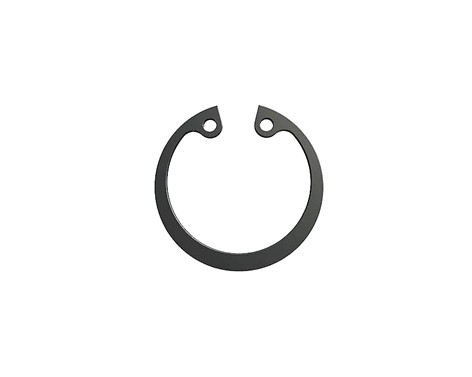
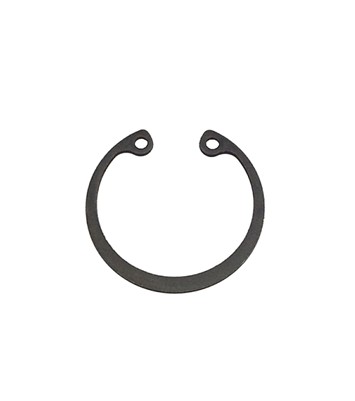
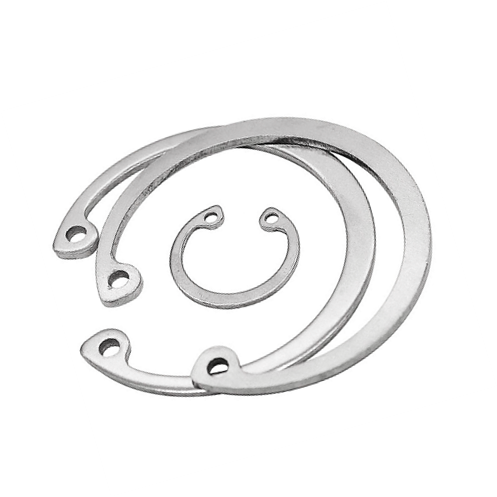
When precision engineering demands reliable, high-capacity retention inside a bore, look no further than the DIN 472 Internal Circlip. Engineered as the definitive safety device for components fitted within internal grooves, these premium retaining rings ensure that your bearings, pins, and assemblies remain locked firmly in place, even under heavy uniform thrust loads.

Maximum Thrust Load Capacity: Featuring an optimized free diameter and gap width, our circlips seat tightly into internal grooves, transferring substantial axial forces securely to the housing wall.
Rapid Installation & Maintenance: Designed with integrated luggage holes, they allow for instant, controlled fitting and removal using standard circlip pliers.
Eliminate Bulky Hardware: Replace heavy threaded fasteners, shoulder plates, and pins with a sleek, low-profile alternative that saves weight and space.
Industrial-Grade Materials: Available in high-tensile Carbon Spring Steel (with a protective phosphate and oil finish) or corrosion-resistant Stainless Steel for marine and harsh chemical environments.

Specifications & Availability

  • Bore Diameters Supported: Broad metric size range from 8.0mm up to 200mm+.
  • Manufacturing Standards: Fully compliant with strict metric DIN 472 guidelines for dimensional accuracy and structural tolerance.

Browse our range of DIN 472 Internal Circlips using the links below.

DIN 471 and DIN 472 Circlips: The Engineering Essentials for Shaft and Bore Retention

In mechanical engineering, securing components onto shafts or inside bores without adding excessive weight or bulk is a foundational challenge. The industry standard solutions for this are DIN 471 and DIN 472 circlips—also known as retaining rings. Though they look similar to the untrained eye, these two fasteners serve opposite geometric purposes. Understanding their differences, installation methods, and failure modes is critical for ensuring machinery longevity and safety.


The Core Difference: External vs. Internal

The fundamental distinction between DIN 471 and DIN 472 lies in where they are mounted and how they exert their spring force.

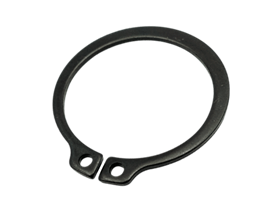
  • DIN 471 (External Circlips): These are designed to secure components onto the outside of a shaft. They are installed into a machined groove on the shaft’s exterior. To fit them, the ring must be expanded outward using specialised pliers. Once released, the ring tightly grips the bottom of the groove. The lug ears (the tips with the small holes) point outward so they do not interfere with the shaft surface.
  • DIN 472 (Internal Circlips): These are engineered to retain components inside a bore or housing. They fit into a groove machined into the internal wall of a hole. During installation, the ring is compressed inward. Once inside the bore and aligned with the groove, it expands outward to lock itself into place. The lug ears point inward to prevent interference with the housing wall.

Design, Geometry, and Materials

Both standards dictate a tapered radial wall design. The ring is thickest opposite the opening and tapers down toward the lugs. This specific geometry ensures that the circlip maintains a perfectly circular shape when expanded or compressed, distributing clamping pressure evenly around the entire circumference of the groove.


Critical Engineering Considerations

Successfully implementing DIN 471 and DIN 472 circlips requires precise calculation of the application’s mechanical limits:

  1. Groove Dimensions: The depth, width, and sharpness of the groove radii are strictly defined by the DIN standards. If a groove is machined too shallow, the ring will not seat completely, drastically reducing its load capacity.
  2. Thrust Load Capacity: Circlips are designed to withstand axial forces (forces pushing along the length of the shaft or bore). This capacity is split into two limits: the shear strength of the circlip itself and the load-bearing wall strength of the groove material. If the groove material (e.g., aluminium) is softer than the spring steel circlip, the groove wall will fail long before the circlip shears.
  3. Centrifugal Force (DIN 471 specific): Because external circlips cling to a shaft, high-speed rotation can cause centrifugal force to expand the ring outward. If the shaft spins fast enough, the circlip can lift out of its groove entirely. For high-RPM applications, special self-locking circlips or heavy-duty variations must be used.

Best Practices for Installation and Maintenance

Improper handling is the leading cause of circlip failure. Engineers and technicians should adhere to the following guidelines:

  • Use the Right Tools: Always use dedicated circlip pliers (external pliers for DIN 471, internal pliers for DIN 472). Using screwdrivers or makeshift tools bends the rings permanently.
  • Avoid Over-stressing: Only expand or compress the ring just enough to clear the shaft or enter the bore. Over-stretching exceeds the material’s elastic limit, leaving the ring permanently deformed. A loose circlip will quickly vibrate out of its groove.
  • Orientation Matters: Circlips are stamped out of sheet metal, leaving one sharp edge and one slightly rounded edge. The sharp edge should always face away from the retained part to ensure maximum contact area against the groove wall.
  • Never Reuse Stressed Rings: If a circlip has been removed during maintenance and shows signs of permanent distortion or loss of tension, it must be discarded and replaced.

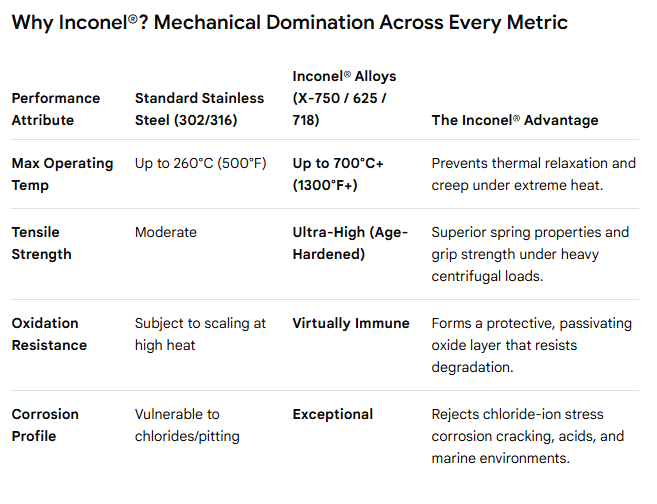
INCONEL® Circlips / Retaining Rings – Uncompromising Retaining Power for Extreme Environments

When standard carbon or stainless steel circlips fail under violent temperatures and aggressive corrosion, Inconel® Circlips keep your critical assemblies locked tight. Engineered for high-stress aerospace, automotive, and marine environments, these circlips provide ultimate structural integrity where mechanical failure is not an option.
Engineered for Industry-Critical Applications

  • Aerospace & Aviation: Securing turbine assemblies, exhaust systems, and fuel control valves subject to rapid thermal cycling.
  • Motorsport & Performance Automotive: Critical retention inside turbochargers, high-performance valvetrains, and exhaust manifolds.
  • Oil, Gas & Petrochemical: Downhole drilling tools, subsea valves, and process piping exposed to sour gas (H₂S) and high pressures.
  • Marine Engineering: Fasteners and shafts continuously submerged in highly corrosive seawater environments.

Upgrade to Absolute Reliability. Request a Quote Today.

Don’t let a minor component cause a catastrophic system failure. Switch to the unyielding strength of Inconel Circlips.

📥 Contact our Sales Team today at sales@calebcomponents.com or call us on +44 (0)121 661 6664
Circlips in Oil & Gas: Engineering for Extreme Environments

In the oil and gas sector, component failure is not an option. Upstream drilling, midstream transport, and downstream processing equipment operate under some of the most hostile conditions on earth. Circlips—also known as retaining rings—play a critical role in these systems by securing bearings, shafts, and assemblies inside valves, pumps, and drilling tools.

When specifying retaining rings for oil and gas applications, standard carbon steel components are rarely sufficient. Engineers must account for extreme pressures, corrosive chemicals, and severe temperature fluctuations.


Key Technical Challenges

  • Corrosion Resistance: Components face constant exposure to sour gas (H₂S), carbon dioxide (CO₂), brine, and seawater. Standard materials suffer from rapid pitting and stress corrosion cracking.
  • High-Pressure, High-Temperature (HPHT): Downhole drilling tools operate at temperatures exceeding 200°C and pressures above 15,000 psi. Retaining rings must maintain their mechanical properties and gripping power without losing temper.
  • Hydrogen Embrittlement: High-strength steels exposed to corrosive environments can absorb hydrogen, leading to sudden, catastrophic brittle failure under tensile stress.

Material Selection Criteria

Material selection is the most critical factor for circlips in oil and gas applications. Standard rings are typically swapped for high-performance alloys:

Material ClassCommon AlloysPrimary BenefitTypical Application
Stainless Steel316 Stainless, 17-7 PHGeneral corrosion resistance and excellent fatigue strength.Surface pumps, valves, and marine topside equipment.
Nickel AlloysInconel X-750, Inconel 718Exceptional strength at high temperatures; resists sour gas.Downhole drilling tools, subsea valves, and completions.
Copper AlloysPhosphor Bronze, Beryllium CopperNon-magnetic and non-sparking properties; low friction.Measurement-while-drilling (MWD) tools and explosive zones.

Here at Caleb Components, we are specialists in sourcing & supplying high quality Circlips in the above materials. Please contact us today with your enquiry.

Internal Circlips: What They Are and How to Use Them

When securing components inside a mechanical housing, you need a fastening solution that is reliable, space-saving, and capable of handling high rotational forces. Enter the internal circlip—also frequently called an internal retaining ring.

Though small and often hidden from view, these components are vital to the structural integrity of automotive transmissions, electric motors, and heavy machinery.


What is an Internal Circlip?

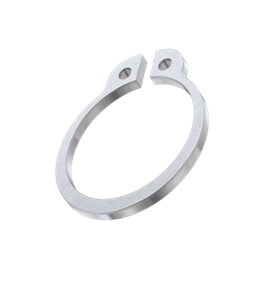
An internal circlip is a semi-flexible, engineered metal ring with an open end. Unlike external circlips, which stretch open to fit over a shaft, internal circlips are designed to be compressed inward. They are installed directly inside a cylinder, bore, or pipe housing.

Once fitted into a specially machined groove inside the bore, the ring snaps outward. This creates a strong, rigid shoulder that prevents bearings, pins, or gears from slipping out horizontally.

       [Housing Wall] 
  _______________________

 |   __  [Groove]  __   |
 |  |  |          |  |  |
 |  |  |==[CLIP]==|  |  | <--- Fits tightly into internal groove
 |  |__|          |__|  |
 |_______________________|

Key Mechanics and Design Features

  • The Lug Holes: Look closely at an internal circlip, and you will notice two small tabs with holes at the open ends. These are lug holes. They allow specialized pliers to grip the ring securely during installation and removal.
  • Sizing Rules: Internal circlips are always categorized and purchased by the nominal bore diameter (the inside diameter of the housing), not the diameter of the groove or the uncompressed ring itself.
  • Tapered Design: The ring’s width decreases from the top center down to the tips. This specific geometry ensures that the circlip maintains a perfectly circular shape when compressed, distributing pressure evenly across the housing groove.

Our Internal Circlips are available to purchase directly online.

Learn more about our D1400 & D1300 Circlips…

D1400 are External Circlips and D1300 are Internal Circlips, and are the most popular form of Standard Circlips.

The D1400 External Circlips are the same as DIN 471 External Circlips and are designed to be fitted on to shafts with grooves.

D1300 Internal Circlips are the same as DIN 472 Internal Circlips are are used within bores with grooves.

We stock these Circlips online in Carbon Spring Steel and Stainless Steel. However other bespoke materials can be quoted for, including Inconel, Titanium and Phosphor Bronze.

To order directly online, please follow this link below.

The Design of Internal Circlips

Internal Circlips are an open ring with two lugs at the end, facing internally.

These circlips are designed to be fitted into bores with the circlip fitting into the groove of the bore.

The internal lugs allow the circlip to be compressed with circlip pliers to aid with the installation and removal of the circlip.

Materials available for internal circlips include, carbon spring steel, stainless steel (including 316 grade stainless), inconel and titanium.

Other varieties of internal circlips are also available, including inverted lug and increased abutment circlips.

View our full range of internal circlips online using the link below.

Have an enquiry for internal circlips? Please contact us today, and we will be happy to help.

Circlips for Car Garages

We have over 20 years experience in supplying a wide range of Circlips for various car garages around the UK.

Our range includes, DIN 471 & DIN 472 Circlips, N1400 / N1300 Imperial Circlips, D2000 / D2100 Increased Abutment Circlips, M1408 / M1308 Inverted Lug Circlips & many more.

You can explore our full range by using the link below:

Large range of External Circlips in stock

We stock one of the UK’s largest range of External Circlips – designed for shafts with grooves.

Our range includes:

  • Metric DIN 471 (D1400) in Carbon and Stainless Steel
  • Imperial N1400 in Carbon and Stainless Steel
  • Inverted (Balanced Lug) M1408 & N1408
  • Increased Abutment (D2100)
  • Grip Rings
  • Crescent Rings

Shop our wide range directly online, and receive the next working day.