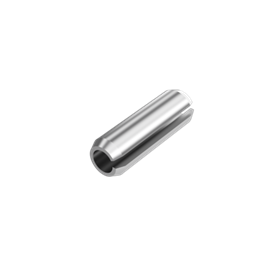
In the world of manufacturing, maintenance, and product design, engineers are constantly looking for fasteners that balance strength, ease of installation, and cost-efficiency. Threaded bolts require tapped holes, rivets are permanent, and solid dowel pins demand absolute, microscopic precision during drilling.
Enter the stainless steel spring pin (also widely known as a roll pin or slotted pin).
What is a Stainless Steel Spring Pin?
A spring pin is a hollow, cylindrical fastener with a longitudinal slot or a coiled cross-section. They are intentionally manufactured with an outer diameter (OD) slightly larger than the hole into which they will be installed.
     Slotted Spring Pin                 Coiled Spring Pin
       _____________                      _____________

      |   _______   |                    |  _________  |
      |  |       |  |                    | |  _____  | |
      |  | [Slot] |  |                    | | |     | | |
      |  |_______|  |                    | |_|_____|_| |
      |_____________|                    |_____________|
    (Flexes via single slot)            (Flexes like a coil sheet)
As the pin is driven into the hole, its spring-like construction allows it to compress. The continuous outward radial force exerted by the pin against the hole wall creates a powerful friction lock, ensuring it stays firmly anchored without the need for nuts, threads, or retaining rings.
Whether you are anchoring a gear to a shaft, building a rugged outdoor hinge, or assembling precision medical equipment, stainless steel spring pins provide a low-cost, high-reliability solution. They cut down on machining time by eliminating the need for tapped threads, while their innate spring tension guarantees they won’t vibrate loose under stress.